
Study after study, report after report, and of course common sense and our own eyes are telling us that unions help people and the economy do better. It's obvious. But the billionaires and big corporations want to keep pay and benefits low, and pay politicians to keep it that way.
Which Democratic presidential candidates will come out in favor of strong labor rights and the laws and regulations that protect and encourage this?
A new report presented by the Center for American Progress co-authored with economists Richard Freeman and Eunice Han is only the latest look at how labor unions enable working people to do better. The report, "Bargaining for the American Dream: What Unions do for Mobility," looks at "economic mobility" and "intergenerational mobility" and finds that mobility is better where unions are strong.
Big words, but what does this mean for real people? The study found that areas with higher union membership demonstrate more mobility for low-income children:
● Low-income children rise higher in the income rankings when they grow up in areas with high union membership.
● An increase in union density is associated with an increase in the income of an area’s children – as much as or more than high school dropout rates.
● Children of non-college-educated fathers earn more if their father was in a labor union.
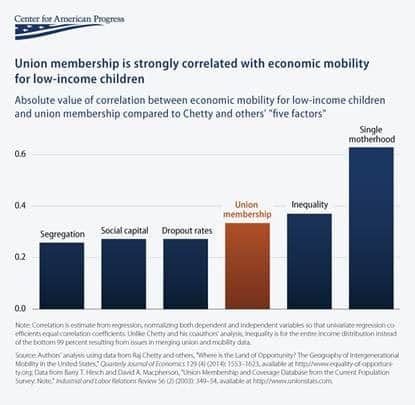
Previous studies had looked at how other factors affected mobility: single motherhood rates, income inequality, high school dropout rates, social capital and segregation. But they had not looked at union membership. This study did look at this and found that the effect of union membership is close to the effect of inequality; only single motherhood has more of an effect.
At an event about the report, former Treasury Secretary Larry Summers (starting about 12:35 in the video) was rather pro-labor. He congratulated the authors for the study, but warned not to necessarily interpret the results as causal. He said the data used could also show that it's the policies of the old Confederate states that cause lower mobility. Those states "are set up to produce a lot of immobility." Are unions a cause or a symptom of that? The data show that holding all other factors constant, being in a union does appear to mean your children and grandchildren will do better.
Summers said private sector unionism by its nature goes hand-in-hand with private sector monopoly power and monopoly profits. Unions make sure that workers share in it. But government policies have assisted in making union organizing difficult, thereby decreasing membership.
[fve]https://youtu.be/ZlIjVYsQAms[/fve]
The report suggested ways that unions might promote increased mobility. Union jobs pay more, which can lead to better outcomes for the kids in union families. Union jobs are often more stable, leading to a stable living environment for children to grow up in. Union jobs tend to come with family health insurance.
These gains show up in children who are not from union families but come from more densely unionized regions. This could be because unions push up wages generally, not just union members, and fight for programs that benefit everyone, especially low-income people.
What Can We Do?
While studies, reports, common sense and our eyes show us that people and our economy do better when workers are able to organize to fight the power of organized wealth, organized wealth is winning. Public policy increasingly supports wealth over working people. Unions are in decline, public investment is in decline, income inequality is rising. Even in times of political domination by Democrats, such as the early years of the Obama administration, little is done to reverse these policies and help working people.
In this presidential campaign Republicans are overwhelmingly speaking out for the interests of the billionaire class that funds them. For example, "Jeb!" Bush has introduced a plan to dramatically cut taxes for the rich. The Republican frontrunner is an actual billionaire.
On the Democratic side, frontrunner Hillary Clinton largely avoids championing specific policy proposals, and in spite of populist language is suspected of supporting the wealth/corporate-owning class. Opponent Bernie Sanders initiated his campaign in an attempt to "move Clinton to the left," to get her to endorse specific policies that could address the problems of increasing inequality and the decline in pro-worker, pro-labor policies that worsen inequality. Interestingly, he is rising in the polls and even overtaking Clinton in some states as a result of his message.
Will the Democratic Party at large see this and rally for stronger labor laws as part of their plan to fight inequality and raise wages? If Bernie Sanders gets the votes to win the nomination and become the candidate, will the party apparatus fall in line? Or will they continue to provide only lip service – and lose elections?